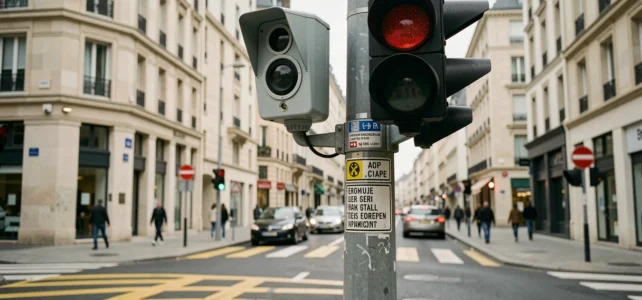
Driving in the city, we approach an intersection equipped with boxes mounted on poles, and the question arises: is it a radar capable of issuing fines, or a simple traffic management camera? Confusion is common, and it has concrete consequences for the driving license. Distinguishing between these devices allows one to anticipate penalties and adjust driving behavior at monitored intersections.
Intersection Camera or Red Light Radar: Understanding What’s Mounted on the Pole
On the ground, a dark box attached to a metal pole can be two very different things. The visual resemblance is misleading, but the operation is entirely different.
Intersection cameras are tools for traffic flow management. They count vehicles, detect the approach of a bus or tram to trigger priority at the traffic light, or feed into an adaptive regulation system. They are sometimes referred to as “virtual loop detectors,” as they replace the magnetic loops that were once buried in the roadway. No license plates are photographed for punitive purposes.
The red light radar operates differently. Certified and connected to the automated control system, it is linked to the traffic light to know precisely when the signal turns red. Two ground sensors detect when the stop line is crossed.
Two photos are then taken: one at the moment of crossing the line, the other in the intersection, proving that the vehicle continued its path after the red light.
To clearly understand the differences between cameras and red light radars, one can rely on a reliable criterion: only the certified radar generates an automated ticket sent to the ANTAI.
Video Ticketing at Red Lights: The Third Device Few Drivers Know About
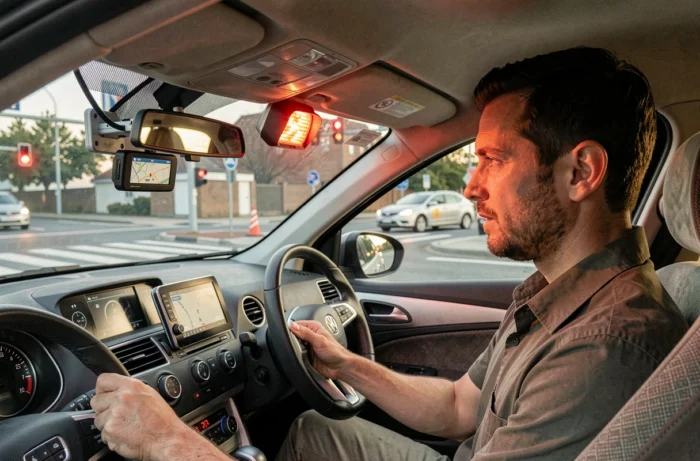
Some municipalities use video ticketing cameras, a device that does not fall into the category of automatic radar or simple passive camera. A sworn officer, often stationed in an urban supervision center, watches the video feed in real-time.
When an infraction is observed, they note the license plate and manually initiate the ticketing procedure. The outcome for the motorist remains the same: a ticket notice received at home, with points deducted.
The difference lies in the mode of proof. The ticket is issued by an officer, not by a certified machine. Feedback varies on this point, but contesting this type of ticketing remains possible, especially if the mandatory video ticketing sign is absent or poorly positioned.
Identifying a Video Ticketing Device as You Approach an Intersection
A sign mentioning “video control” or “video protection” is the first clue. The cameras are generally oriented towards the roadway from a cantilevered pole, without a visible flash. No ground sensors, no radar cabin in sight, but a video ticketing sign present: we find ourselves in this intermediate configuration.
Fines, Points Deduction, and Orange Light: Applicable Penalties
Running a red light is a fourth-class offense under the traffic code. Automatic radar, video ticketing, or an officer on-site: the penalties remain the same regardless of the mode of observation.
- Fixed fine of 135 euros, increased to 750 euros if the payment deadline is exceeded
- Deduction of 4 points from the driving license, which is one-third of the total capital for a 12-point license
- No immobilization of the vehicle or towing for this single infraction
The orange light often causes confusion. In principle, it requires stopping, unless the vehicle can no longer stop safely. A red light radar only activates once the light has turned red, never during the orange phase. However, an officer or a video ticketing camera can penalize running an orange light if the driver clearly had time to stop.
Contesting a Red Light Radar Ticket: Checks to Make Before Paying
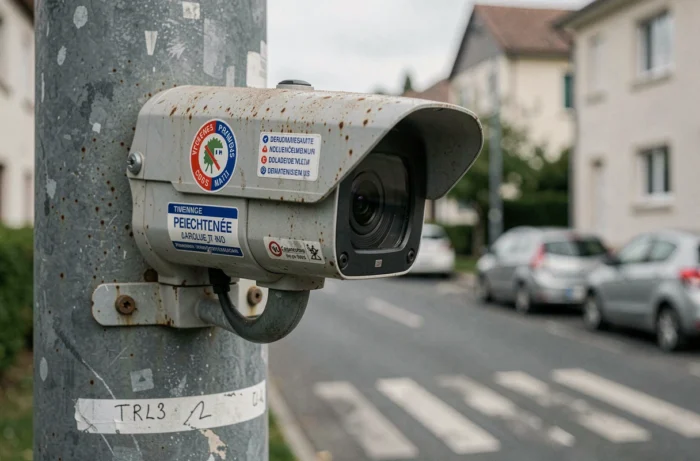
The ticket notice usually arrives by mail within five days of the infraction. It includes a photo showing the vehicle, the license plate, and the red light in the background.
- The photo must clearly show the light as red and the vehicle in violation. Blurry image or light not visible: the ticket can be contested
- If one was not driving, they can designate the actual driver via the exemption request form attached to the notice
As long as the contestation is ongoing, the points deduction is suspended. Consulting a lawyer specializing in traffic law can be relevant when the remaining points balance on the license is low.
Nearly Doubling the Number of Radars by 2031: The Impact on Intersections
According to the Court of Auditors, France had 4,819 automatic radars by the end of 2025. The stated goal is to have 9,819 devices by the end of 2031. This near doubling does not specify the exact share of red light radars, but automated monitoring of intersections will strengthen in the coming years.
The ANTAI considers crossing radars as a tool for protecting vulnerable users at intersections, with pedestrians and cyclists being the primary focus. This official direction targets densely populated urban areas first, where conflicts between vehicles and non-motorized users are most frequent.
The turret radars of the Mesta Fusion type accelerate this dynamic. Capable of combining speed control and red light crossing detection on the same pole, they make the visual distinction between speed radars and red light radars even more difficult for the driver.
Consistently respecting traffic lights and slowing down as one approaches any intersection equipped with a box remains the only reliable strategy. An early stop at the orange light costs a few seconds, while a questionable crossing can cost four points and 135 euros.