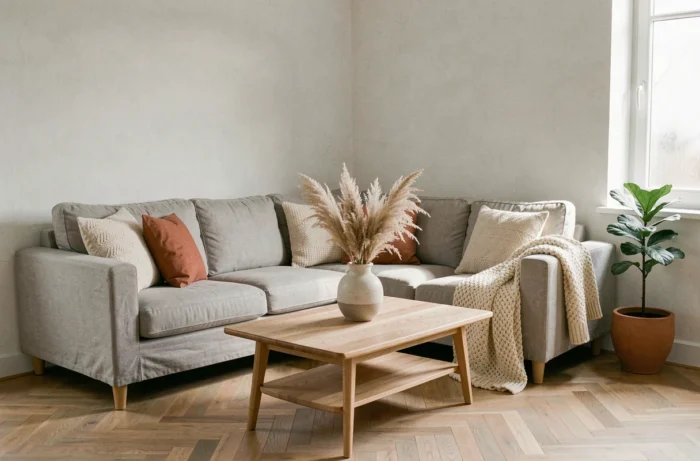
A sofa that sticks to your back but clashes with the room’s style, walls repainted three times in two years, a secondhand find with a lingering smell: we all know those decorating mishaps that turn an exciting project into a source of frustration.
Creating a home that feels like you isn’t about piling on trends spotted on social media. It starts with practical constraints, thoughtful material choices and decisions that suit your everyday life.
Indoor air quality and decorating choices: what your walls breathe matters
We rarely think about air quality when choosing paint or flooring. Paints, varnishes, adhesives and some new furniture can release volatile organic compounds for weeks after installation. This is especially important in a child’s bedroom or a poorly ventilated space.
Before buying, check the emissions label (rated from A+ to C in France). Choosing products rated A+ reduces exposure to pollutants from the very first days. And after painting or installing flooring, airing out the room at least twice a day for several weeks is still the most effective step, even in winter.
The same applies to furniture. Low-cost particleboard furniture emits more than solid wood furniture or secondhand pieces that have already finished off-gassing. For more practical ideas on home design, Atypique Info’s home section regularly covers these topics from a practical perspective.

Reusing and repairing furniture: practical alternatives to buying new
The usual response to damaged or outdated furniture is to replace it. We head to a store or go online and order something new. But reuse and repair are worth considering—not just for environmental reasons, but because they open up decorating possibilities that standard catalogs don’t offer.
Secondhand furniture: check before you bring it home
ADEME tracks reuse by product category and highlights differences between sectors. In practice, it’s often easier to find a vintage dresser in good condition than to find reclaimed kitchen units in the right sizes. Not all reuse networks are equally well developed.
Reclaimed furniture needs more thorough checks than new furniture. Looks alone aren’t enough: check that the joints are sturdy, that there’s no hidden mold (on the back or inside drawers), and, for items attached to the structure (countertops, wall shelves), that they can support the intended load.
- Check the joints (hinges, dowels, screws) and reinforce them if needed before repainting or sanding.
- Inspect the back and underside of the furniture for signs of damp, suspicious stains or wood-boring insects.
- For an item that will be mounted on a wall, make sure the material can withstand drilling and the intended weight.
Furniture repair bonus: an overlooked source of help
The furniture sector has a repair bonus. A broken chair leg, a sagging seat, a drawer that no longer slides: before throwing something away, you can contact a registered repairer and get part of the cost covered. Checking that spare parts are available before buying new furniture is also a useful habit: a manufacturer that doesn’t offer replacement parts leaves you with no choice but to replace the furniture as soon as something breaks.
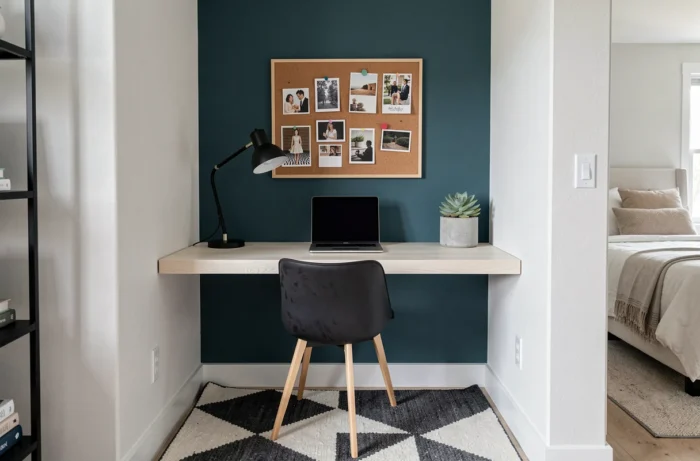
Color palettes and room layouts: start with the space, not the trend
Color trends change every year. The terracotta shades of a few seasons ago have given way to other hues. Following fashion can leave your home looking dated within two years. The opposite approach works better: start with what isn’t going to change.
The room’s natural light, orientation and size, along with the materials already in place (flooring, woodwork), provide the foundation. A north-facing living room with light oak flooring won’t respond to sage green in the same way as a south-facing room with anthracite tiles. Testing the color on an entire wall before committing is the only reliable method: a three-square-centimeter sample tells you nothing about the final result.
Pairing colors and materials without overdoing it
As a rule, limit each room to three dominant colors. Beyond that, the overall look loses clarity. Decorative objects, textiles (cushions, curtains, rugs) and furniture add accents without the need to repaint.
- An accent wall in a bold shade works better than four walls in different colors.
- Natural materials (linen, wool, unfinished wood, terracotta) pair effortlessly, whatever palette you choose.
- Personal items (travel souvenirs, handmade crafts, books) add a distinctive touch that no home décor store can replicate.
A cohesive interior depends less on its stated style than on how well its elements work together. A space where every object has a reason to be there, whether practical or sentimental, always feels more complete than a room straight out of a catalog.
Indoor lighting: the factor most decorating projects overlook
We choose the furniture, colors and textiles, then screw in a ceiling bulb and move on. Yet lighting changes a room’s atmosphere more dramatically than almost anything else—even a change in wall color.
Adding light sources at different heights turns a flat space into a room with depth and character. A reading lamp by the sofa, indirect lighting on a shelf, a low-hanging pendant above the table: each light creates a functional zone and adds dimension.
The bulb’s color temperature matters as much as its brightness. Warm light (around 2700 K) suits relaxing spaces, while more neutral light works better over a countertop or at a desk. Mixing the two in the same room without thinking it through creates a diffuse visual discomfort that’s hard to identify but very real.
A home that feels like you doesn’t come together in a weekend of shopping. It’s the result of a series of informed decisions, from the paint you choose to the type of light bulb. The best interiors are those where every element has been chosen for a specific reason, not just to fill an empty space.