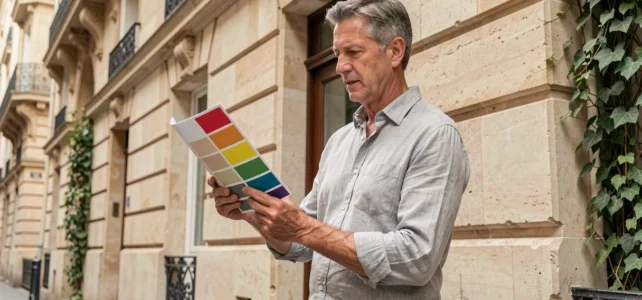
Repainting a facade or changing the color of shutters in a protected area is not just about flipping through a RAL color chart at a DIY store. The palette of acceptable shades depends on local regulations, the Departmental Unit of Architecture and Heritage (UDAP), and often, a direct dialogue with the Architect of Buildings of France (ABF). The RAL color chart, although widely used in the industry, is just one tool among others in this process.
RAL Color Chart and Protected Areas: A Common Misunderstanding
The RAL color chart includes several hundred shades coded by a four-digit system. It is used in the paint, metallurgy, and construction industries to ensure an exact match between the ordered color and the applied color. Many individuals believe that simply choosing a “discreet” RAL code will secure the ABF’s approval. The reality is more nuanced.
In protected areas, the ABF thinks in terms of overall coherence, not isolated color codes. The analysis focuses on the street, materials, and the era of the surrounding buildings. A RAL color may only be accepted if it corresponds to the local color chart validated by the UDAP. Some municipalities also use competing systems like the NCS (Natural Color System) or Munsell, depending on the practices of their heritage service.
To delve deeper into the issue of RAL color chart and authorized colors for Buildings of France, it is essential to understand that each department can adopt its own color charter, independent of the RAL system.
Local Color Charter: What Really Determines Authorized Shades
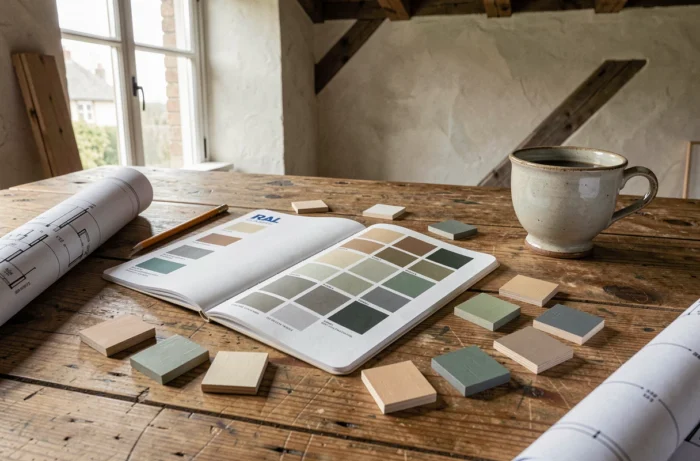
The municipal or departmental color chart is the authoritative document, not the RAL catalog from the paint manufacturer. This chart is developed by the UDAP in conjunction with the municipality’s urban planning services. It takes into account traditional materials, historical pigments, and the tones of the existing built landscape.
Marked Regional Variations
The palettes vary significantly from one territory to another. In Provence, ochres and earth tones dominate. In Brittany, the town of Dinan has a specific color chart for the doors in its protected sector, with shades validated one by one by the ABF. In Côte-d’Or, the Departmental Service of Architecture and Heritage has published advisory sheets reminding that the colors of buildings must blend into the landscape without imposing themselves.
The Paris Local Urban Plan (PLU), for its part, does not set a specific color chart. Facades must harmonize with the existing environment, and validation is done on a case-by-case basis during the review of the application. This approach based on harmony rather than a closed list is not an isolated case.
Where to Find the Applicable Color Chart
- The urban planning department of the town hall, which holds the PLU regulations and its article 11 (external appearance of constructions), often accompanied by an annexed color chart
- The UDAP of the department, which can provide the departmental color charter or specific prescriptions for the relevant protected sector
- The CAUE (Council for Architecture, Urban Planning, and the Environment), which offers free support and often has resources on local palettes
Prior Declaration and ABF Opinion: The Procedure in Protected Areas
Any change in color that alters the external appearance of a building requires the submission of a prior declaration (DP) to the town hall, in accordance with article R421-17 of the Urban Planning Code. In protected areas, the review period extends to two months instead of one month in ordinary zones, because the file is sent to the ABF for opinion.
A often underestimated point: even a so-called “identical” replacement may still be subject to formalities or control in a protected area. Outside the protected perimeter, repainting in the same shade generally escapes the declaration requirement. In a Remarkable Heritage Site (SPR) or in the vicinity of a historical monument, the opinion of the Buildings of France may still apply.
Key Documents for the Application
Recent applications emphasize visual proof. Facade plans must show the existing state and the proposed state, with verifiable shade references (RAL code, NCS, or manufacturer color chart). A simple commercial paint name is not sufficient. The ABF wants to be able to objectively compare the proposed shade with the local palette.
- Facade plan of the existing state, with a photograph of the street and adjacent buildings
- Facade plan of the proposed state, with precise indication of the chosen color code and the support (rendering, wash, stain)
- Physical or digital sample of the shade, if requested by the UDAP
ABF Refusal on the Shade: Real Margins for Maneuver
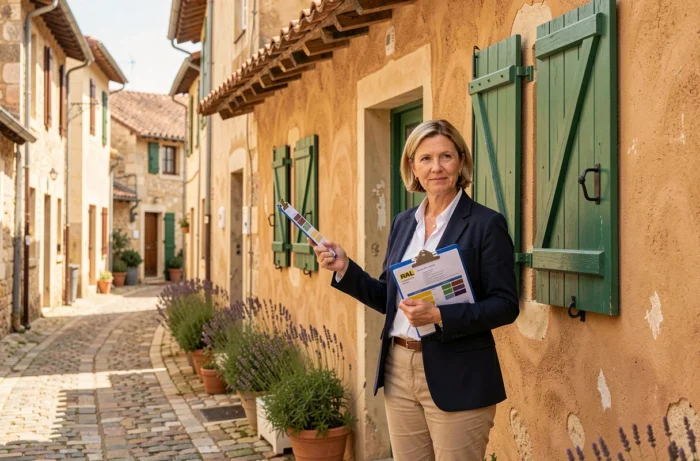
An ABF refusal rarely stems from an aesthetic whim. Common reasons involve a stark contrast with the surrounding buildings, the use of pure white (often prohibited in old centers), or the use of a shade absent from the local color chart. The refusal is justified in the opinion, which allows understanding of the issues at hand.
A hierarchical appeal to the regional prefect remains possible if the applicant contests the ABF’s opinion. This appeal allows for the file to be re-examined by a higher level. However, feedback from the field varies regarding the actual effectiveness of this procedure: obtaining a favorable outcome generally requires demonstrating that the proposed shade objectively integrates into the heritage environment.
Dialogue in advance with the ABF, before the formal submission of the prior declaration, remains the most reliable way to avoid a refusal. Most UDAPs offer a free advisory meeting to discuss the project, materials, and intended shades.
Choosing a facade color in a protected area falls under a much more precise local regulatory framework than a simple RAL catalog. The relevant color chart is that of the UDAP or the PLU, not that of the paint aisle. Consulting the urban planning service of one’s municipality and, if possible, meeting with the ABF before submitting the application remains the safest approach to avoid a refusal or a redo of work.