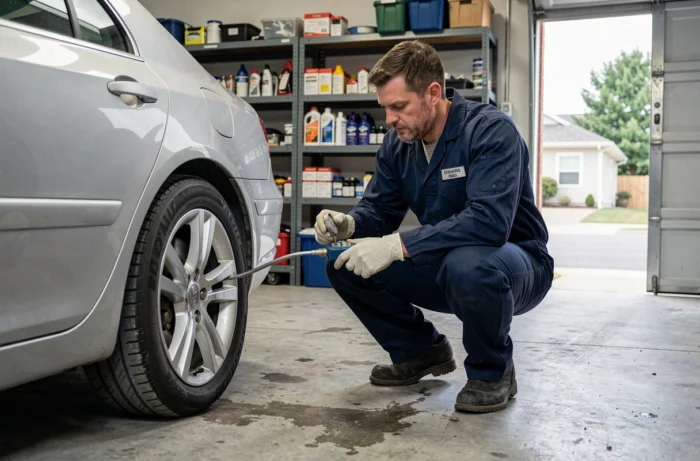
A vehicle whose maintenance log is meticulously followed can still experience failures if certain technical points are neglected between two services. We regularly observe avoidable breakdowns related to parameters that general public guides do not detail: tire compliance, actual state of the braking system, or aging of the timing belt well before the theoretical mileage deadline.
Tire Compliance and Recent Regulatory Requirements
Since November 1, 2024, the simple “M+S” marking is no longer sufficient to meet the obligations of the Mountain Law. Only the 3PMSF (Three-Peak Mountain Snowflake) symbol guarantees winter compliance in the affected areas.
This rule also applies to light commercial vehicles, which are often overlooked. Heavy trucks, on the other hand, must also carry chains even when they are already fitted with winter tires.
Beyond seasonal regulations, the technical inspection penalizes inappropriate tire fittings: non-compliant dimensions, incompatible load or speed indices, or two different tires on the same axle can lead to a refusal. We recommend checking these elements on the tire sidewall before each inspection, as technical sheets and resources like https://zone-auto.eu/ allow for a quick cross-reference of the vehicle’s original specifications with the current tire setup.
Another underestimated point: the legal tread depth does not guarantee actual effectiveness. On winter tires, the advantage on snow decreases significantly before reaching the regulatory threshold. An early replacement remains the best option to maintain reliable grip.
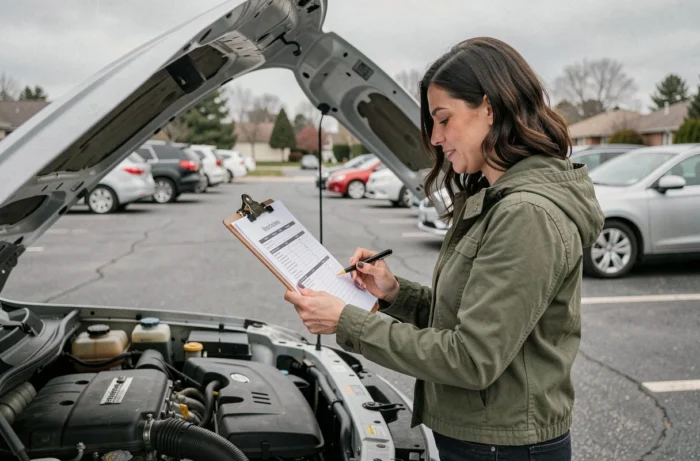
Braking System: Checks That Standard Maintenance May Not Always Cover
The thickness of the brake pads is checked during maintenance, but the brake fluid ages independently of mileage. Its hygroscopic nature means it absorbs ambient moisture over the months. Beyond a certain water content, the boiling point drops and the risk of vapor lock increases, especially during prolonged descents or heavy driving.
We recommend a test with a refractometer (available in most workshops) rather than relying solely on the manufacturer’s calendar interval. Degraded brake fluid is not visible to the naked eye.
Hoses and Calipers: Silent Parts
Brake hoses lose their flexibility over time. A stiffened hose poorly transmits hydraulic pressure, resulting in a long or spongy pedal without visible leaks. Calipers, on the other hand, can seize on one side, causing asymmetric wear of the pads and a deviated trajectory during braking.
- Visually inspect the hoses at each pad change: cracks, bulges, or abnormal twists indicate a necessary replacement.
- Check the sliding of the calipers by manually pushing back the piston. Excessive resistance indicates a developing seizure.
- Monitor differential wear of the pads between the left and right wheels on the same axle: a marked discrepancy points to a caliper or hose issue.
Timing Belt and Wear Parts to Monitor Between Services
The timing belt does not always break at the expected mileage. Heat, repeated short cycles, and prolonged parking accelerate the aging of rubber. On certain interference engines, a break can lead to the destruction of the valves or even the block.
We observe breaks on belts still “within the limits” in mileage but having exceeded their age limit. The maintenance log usually mentions a dual deadline (mileage or duration), but the latter is often ignored by owners who drive little.
Battery and Charging System
A battery provides power even at the end of its life, up until the morning it no longer starts. The open-circuit voltage is not sufficient to assess its condition: it is the capacity test under load that reveals its actual health. Repeated short trips (less than twenty minutes) do not allow the alternator to compensate for the starting consumption, which accelerates the sulfation of the plates.
A multimeter costing a few euros detects abnormal voltage at idle, but only a professional load tester evaluates the actual residual capacity.

Fuel Maintenance and Supply Circuit on Moderately Driven Vehicles
Vehicles that mainly accumulate short urban trips suffer from accelerated fouling. On recent diesel engines equipped with a particulate filter, regeneration only occurs at a stabilized speed on the road. A DPF that never regenerates eventually clogs, triggering a check engine light and significant power loss.
On direct injection gasoline engines, carbon deposits on the intake valves are not cleaned by standard additives mixed with fuel, as the fuel no longer comes into contact with the valves. Periodic decarbonization or phases of driving at sustained RPM limit accumulation.
- Plan at least one prolonged highway trip per month to allow DPF regeneration on diesels.
- On direct injection gasoline, consider cleaning the intake valves when replacing the spark plugs.
- Replace the fuel filter at the recommended interval, even if no symptoms appear: a partially clogged filter starves the engine under load without triggering a warning light.
Automotive maintenance goes far beyond oil changes and filter replacements. The points discussed here, tire compliance, state of the braking system, calendar aging of rubber parts, and fouling of the supply circuits, represent the most common blind spots. Addressing them between services reduces the risk of breakdown as well as the overall ownership cost.