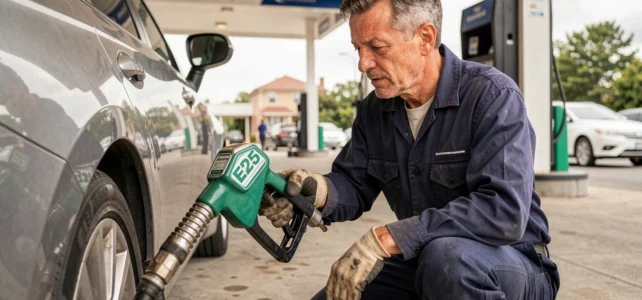
The E25 fuel refers to a blend composed of 75% traditional gasoline and 25% ethanol. Unlike SP95-E10, which is limited to 10% ethanol, or Superethanol E85, which contains up to 85%, E25 occupies an intermediate position rarely offered at European pumps. However, some manufacturers mention E25 compatibility on the fuel filler flap of their vehicles, raising legitimate questions about its availability, effects on the engine, and its real benefits.
Engine Compatibility and Manufacturer Standards for E25
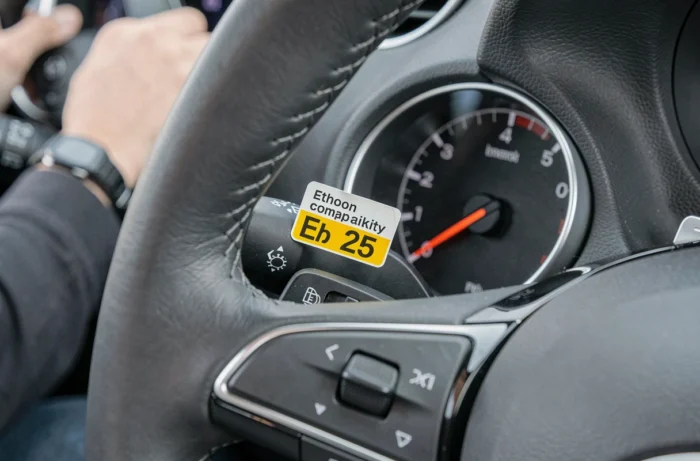
The first instinct when faced with a less common fuel is to check what the manufacturer allows. Several brands indicate on the fuel flap compatibility up to E25, sometimes even E30. This mention means that the seals, hoses, and injection system have been designed to withstand an ethanol content higher than that of SP95-E10.
Ethanol is a more aggressive solvent than fossil gasoline. Beyond a certain concentration, it can attack elastomers and cause accelerated corrosion in circuits not intended for this use. An E25 compatible vehicle incorporates materials resistant to this corrosion, which is not the case for all models in circulation.
For those who want to know everything about E25 fuel, the question of compatibility remains the starting point before any consideration of price or ecology. Using a fuel with a high ethanol content in an engine not designed for it exposes one to long-term damage, even if the effects are not immediate.
E25 in Europe: Why This Fuel Is Absent from Service Stations
European regulations govern the fuels distributed at pumps through precise standards. In France, the fuels available at stations are SP95-E5, SP95-E10, SP98, Superethanol E85, and diesel. No specific distribution standard for E25 exists within the current regulatory framework.
This absence is explained by a political and industrial choice. Europe opted for a direct jump from E10 to E85, reserving the latter for Flex-Fuel vehicles or those equipped with approved conversion kits. Intermediate blends (E20, E25, E30) remain in a regulatory blind spot.
The Brazilian Case as a Global Reference
Brazil has been distributing E25 (and sometimes E27) as a standard fuel for several decades. This choice is based on a massive sugarcane industry and a vehicle fleet adapted from the design stage. Transposing this model to Europe would require a complete overhaul of distribution standards, adaptation of the existing fleet, and ethanol supply at a scale that European production does not currently cover.
Field feedback varies on this point: some European motorists mix E10 + E85 themselves to achieve an ethanol level close to 25%. This practice, common on specialized forums, is not backed by any manufacturer guarantee or official standard.
Common Misconceptions About E25 Fuel and Technical Reality
Several claims circulate around fuels with medium ethanol content. Some deserve to be examined with caution.
- E25 consumes more than SP95: ethanol contains less energy per liter than fossil gasoline. At a proportion of 25%, overconsumption exists but remains moderate compared to E85. The exact gap depends on the engine, driving style, and the ECU mapping.
- E25 is necessarily cheaper: in the absence of official distribution in France, no reference price is available. Superethanol E85 has an average price of 0.864 euros per liter, significantly lower than SP95-E10, but the hypothetical E25 would be positioned between the two without a guarantee of a favorable price.
- E25 cleans the engine: ethanol does indeed have detergent properties. It can dissolve certain deposits in the fuel system, but this action can also release impurities that clog the fuel filter, especially during the first fills on an older vehicle.
- E25 reduces pollutant emissions: the combustion of ethanol produces less fossil CO2 at the exhaust. However, the overall carbon footprint depends on the cultivation, transport, and processing of the raw material used to produce this ethanol.
Normative Evolution of Fuels in France: What Changes in 2025-2026
A recent decree introduced several modifications in the regulation of fuels distributed in France. Among the new requirements, a mandatory mention “Contains metallic additives” must now appear on pumps when metallic additives are present in E5 and E10 gasoline.
This same regulation sets a manganese limit of 2 mg/L in unleaded superfuels. For diesel, the number of particles at the certification point is capped at 10,000 particles of at least 4 micrometers.
These normative developments do not directly concern E25, but they outline the framework within which any new blend should fit to access distribution. The integration of a fuel like E25 into European standards would require composition specifications, additive thresholds, and certification procedures that do not yet exist.
Flex-Fuel and Conversion Kits: The Existing Path
While waiting for a hypothetical E25 standard, motorists wishing to run on more ethanol go through Superethanol E85 via an approved kit. The global market for Flex-Fuel vehicles continues to grow, primarily driven by Latin America. Europe remains marginal in this segment, despite growing interest from motorists in fuel savings.
E25 fuel, despite its theoretical qualities (intermediate cost, broader compatibility than E85, partial reduction of fossil emissions), remains a product without a distribution circuit in Europe. Its future will depend as much on regulatory decisions as on the ability of the European ethanol sector to provide sufficient volumes, a parameter on which the available data does not allow for conclusive certainty.