
The full body workout regularly comes up in discussions among weightlifting enthusiasts, whether on specialized forums or in gyms. This method, which involves engaging the entire body in a single session, appeals to both beginners and experienced practitioners. The key is to understand what distinguishes a well-structured full body program from a simple list of exercises assembled without a logical progression.
Measurable Progression: The Criterion that Separates a Good Full Body Program from a Bad One
Most full body programs available online merely list exercises with a number of sets and repetitions. The practitioner performs the same routine week after week, without a framework for advancement. The latest content on the subject emphasizes a specific point: an effective program incorporates a logic of progression session after session.
This progression follows a sequence: first, add repetitions at a given weight, then increase the weight when the upper range of repetitions is reached, and finally, possibly add an additional set. This mechanism contrasts with the static approach where the same parameters remain fixed for weeks.
Before committing to a program, checking whether it includes this progressive overload mechanism is a simple and reliable filter. A program that mentions no progression rules is, at best, incomplete. Several resources detail these criteria, and a JVC Muscle guide on Free Sport lists the program formats discussed by the online community.
A/B/C Structure: Why Alternating Full Body Sessions Makes a Difference

The classic full body scheme relies on three identical sessions per week, spaced by a day of rest (Monday, Wednesday, Friday, for example). This format works, but it has a limitation: the accumulated fatigue from the same movements eventually caps performance, especially among intermediate practitioners.
A trend emerging in content published in 2025-2026 is the A/B/C structure, where each session works the entire body but with a different focus. Session A may emphasize pushing movements (bench press, squat), session B may focus on pulling movements (rowing, deadlift), and session C may mix in variations or modified tempos.
The benefits are twofold. On one hand, local fatigue is better distributed throughout the week. On the other hand, each muscle group receives varied stimuli, promoting adaptation. Field feedback varies on the actual gains compared to a classic format of three identical sessions, but the physiological logic holds for anyone beyond the beginner stage.
Compound Exercises at the Core of the Program
Regardless of the chosen format (A/B/C or identical), effective full body programs share a common point: compound movements make up the bulk of the training volume. Squats, bench presses, deadlifts, pull-ups, and dips form the foundation.
Isolation exercises (bicep curls, tricep extensions, lateral raises) are added as a complement at the end of the session to target weak points. A program that dedicates the majority of its time to isolation movements is not a true full body program; it is a collection of exercises without hierarchy.
- Squat or variation (goblet squat, Bulgarian squat) for the lower limbs and core
- Bench press or military press for upper body pushing
- Dumbbell rowing or pull-ups for pulling and back
- Deadlift (conventional or Romanian) for the posterior chain
- One or two isolation exercises at the end of the session based on individual weaknesses
Six basic exercises should represent the bulk of the volume per session. Beyond that, intensity is diluted without proportional gain.
Full Body Beyond the Beginner: What Recent Formats Show
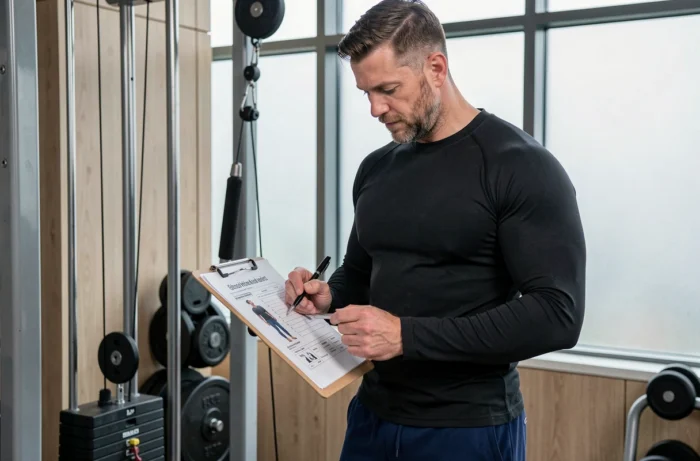
Several recent formats explicitly target intermediate and advanced practitioners with full body sessions structured around intensification techniques. Full body workouts have never been limited to the first months of practice, and their relevance for experienced profiles is confirmed in programs published in recent years.
Methods such as supersets (performing two exercises back-to-back without rest), controlled tempos (slowing down the eccentric phase), or intra-set pauses appear in full body programs designed for practitioners with several years of training. Full body is no longer confined to an initiation role.
However, the total volume per muscle remains lower per session than with a classic split. It is the weekly frequency (two to three sessions per muscle group) that compensates. For a practitioner who can only go to the gym three times a week, the full body remains the format that maximizes the frequency of stimulation per muscle.
Concrete Criteria for Evaluating a Full Body Program Before Following It
Given the number of programs available, a few checkpoints allow for quick sorting.
- Does the program specify a progression rule (adding repetitions, weight, sets)?
- Are compound exercises placed at the beginning of the session, before isolation movements?
- Is the recommended frequency two to three sessions per week with at least one day of recovery between each?
- Does the program offer variations or an alternating structure (A/B/C) for non-beginner practitioners?
A program that checks these four points is likely to be structured correctly. A program that checks none of them deserves to be ignored, regardless of its author’s reputation.
Recovery between sessions directly influences results. A full body workout performed four or five times a week without a rest day generates more fatigue than progress. The three-session spaced format remains the most documented and reproducible for the majority of practitioners.