
Choosing a gas-powered auger means weighing three factors: soil type, the kind of hole you need to drill, and site access conditions. Before comparing engine displacement or auger bit diameters, there’s one often-overlooked factor that can change everything: regulations governing buried utilities.
Even on private property, installing posts or planting trees may require DT-DICT procedures, which involve identifying the utilities concerned and reviewing their responses before drilling. A utility map does not guarantee an exact location, and Prévention BTP points out that the data may be incomplete or imprecise. Comparing models only makes sense once this check has been completed.
Gas-powered augers: a comparison table of selection criteria by job type
Not all jobs put the machine to the same test. Digging a planting hole in loose soil and setting a post in compact clay require very different features.
| Type of work | Typical auger bit diameter | Typical soil | Top priority |
|---|---|---|---|
| Planting trees or shrubs | Medium to large | Topsoil, loose soil | Auger bit diameter and adjustable depth |
| Installing fence posts | Medium | Variable (clay, sand, stones) | High engine torque for hard soil |
| Drilling holes for light foundations | Large | Compact or semi-rocky soil | Engine power and frame durability |
| Occasional jobs (around ten holes) | Variable | Any type | Low weight and easy transport |
This table highlights a key point: engine torque matters more than displacement alone whenever the soil offers resistance. An engine that looks powerful on paper but is poorly matched to the auger bit will struggle in clay, overheat, and cause premature wear to the drive system.
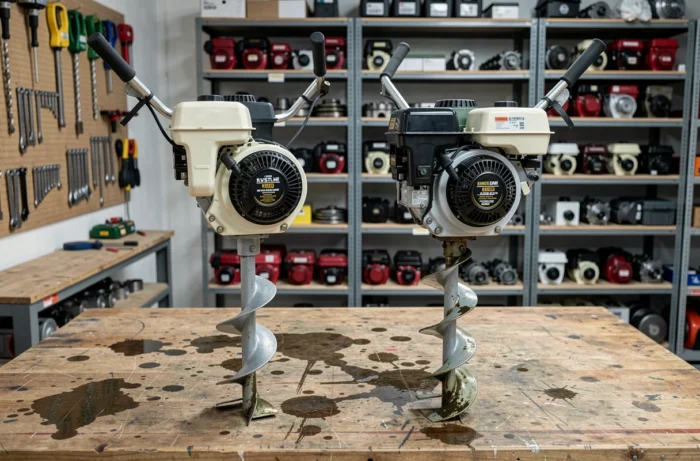
A comparison of professional gas-powered augers lets you assess these technical factors model by model, rather than relying solely on the product specifications.
Vibration and operating time: overlooked factors on the job site
Most buying guides focus on power and diameter. Hand-arm vibration is rarely mentioned, even though it can determine whether a job is manageable once the number of holes starts to add up.
The INRS, cited in Groupe RG’s prevention guide, links hand-arm vibration to potential health effects, including Raynaud’s phenomenon and musculoskeletal disorders. For professional use, cumulative exposure time matters just as much as the machine’s vibration level.
Two models with similar engine displacement can have very different vibration levels depending on the design of the anti-vibration system, the type of handles, and engine balance. The manufacturer’s declared vibration data (in m/s²) is a more reliable way to compare models than the power rating alone.
- Check the declared vibration value in the technical manual before buying, and compare models with similar power ratings.
- Choose handles with an integrated anti-vibration system for any job involving more than a few holes.
- Adjust drilling session lengths: alternating with other tasks reduces cumulative exposure over the course of the day.
For a long fence installation or a large-scale planting job, a less-vibrating tool with comparable performance reduces the risk of health problems far more effectively than taking an extra break.
When a gas-powered auger isn’t the right tool for your site
Surface stones pose a different problem from buried utilities. In the first case, a reinforced auger bit and sufficient engine torque make the job possible. In the second, no auger can “sense” an electrical cable or gas pipe.
No detection method can locate every utility with certainty, according to Prévention BTP. If responses to DT-DICT consultations indicate utilities in the drilling area, or if the plans are incomplete, caution calls for additional investigations by a qualified contractor before inserting an auger bit.
Other situations can make a gas-powered auger unsuitable:
- Access that is too narrow (a passage narrower than the machine, including its handles) prevents safe maneuvering.
- Waterlogged soil turns drilling into a muddy mess and jams the auger bit, putting dangerous strain on the drive system.
- Very occasional work (two or three holes a year) does not justify the investment or maintenance requirements of a gas engine.
For an infrequent job, comparing rental or hiring a professional with buying helps you account not only for the price, but also for preparation, maintenance, and familiarity with the tool. A homeowner installing a fence once in their life has different needs from a landscaper who drills every week.
Gas engine maintenance and auger bit lifespan
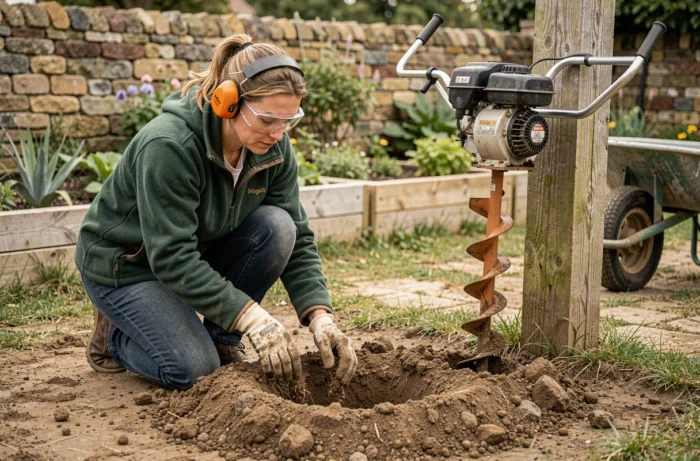
A poorly maintained gas-powered auger loses torque, uses more fuel, and vibrates more. A two-stroke engine requires an oil-gas mixture at the ratio specified by the manufacturer. A mixture that is too lean can damage the cylinder, while one that is too rich can foul the spark plug.
The auger bit wears differently depending on the soil. Clay soil dulls the blades faster than sandy soil because clay sticks to the spiral and creates constant friction. Inspecting the tip and cutting blades before each drilling session helps prevent you from forcing a dull tool, which increases vibration and fuel consumption.
The air filter deserves particular attention on dusty job sites. A clogged filter restricts airflow, degrades combustion, and causes the engine to misfire. Cleaning it after each extended use takes just a few minutes and helps preserve available power.
Choosing a gas-powered auger rarely comes down to a spec sheet alone. Soil type, buried utilities, the number of holes to drill, and vibration tolerance all combine to point toward a specific model, renting, or sometimes a different tool altogether. Checking the site before choosing the machine remains the first step—and the most cost-effective one.