
Games with paper and pencil simultaneously engage fine motor skills, decision-making, and visual production. This combination makes it a particularly comprehensive support for creative stimulation for children, starting from the early years of kindergarten. Unlike a digital activity where options are predefined, a blank sheet imposes no constraints of menu, button, or format: the child starts from scratch and builds everything.
Fine Motor Skills and Creativity: A Link That Digital Cannot Replace
Holding a pencil, adjusting pressure on the lead, directing the stroke: these actions engage the muscles of the hand and forearm in a way that sliding a finger on a tablet does not replicate. The eye-hand coordination required to draw a circle, trace a letter, or connect dots trains neural circuits directly linked to motor planning.
This motor work is not separate from the creative process. A child drawing a character constantly adjusts what they see on the paper to what they imagine. Each stroke becomes a choice: thickening an outline, adding a detail, restarting a shape. This decision-execution-evaluation loop forms the foundation of applied creative thinking.
Recent studies in artistic education distinguish between two types of paper activities: directed activities (coloring within a framework) and open activities (free drawing, inventing games). Both have their merits, but open activities, as detailed in an article published on Le Chaudron Des Jeux, more strongly promote divergent thinking, that is, the ability to produce multiple responses to the same problem.
Paper and Pencil vs. Screen: What Pediatric Recommendations Say
The American Academy of Pediatrics recommends limiting screen time for young children and prioritizing activities that involve hands-on manipulation of materials. Drawing, coloring, and writing on paper are among the modes of exploration and expression valued in these recommendations.
The difference lies in the degree of active involvement of the child. In front of a screen, even an interactive one, the child navigates in a pre-constructed environment: they select, they touch, they validate. With a sheet and a pencil, they plan, they produce, they regulate their emotions in response to the outcome. The screen often places the child in a passive receptive mode, whereas paper demands constant participation.
This does not mean that all digital activity is without value. Some drawing applications partially replicate this dynamic. The distinction lies in the sensory richness: the texture of the paper, the resistance of the lead, the sound of the stroke, the smell of the eraser. These multiple sensory feedbacks fuel the child’s imagination through several simultaneous channels.
Paper-Pencil Games and Divergent Thinking in Children
Divergent thinking, the ability to imagine multiple solutions to a given situation, is a recognized marker of creativity. Paper games engage it repeatedly and naturally.
Take the exquisite corpse: each player draws a part of a character without seeing what the others have done. The result is unpredictable, and the child learns to accept the unexpected as creative material, not as a mistake. The small bac encourages quick searches for words in various categories, which fosters cognitive flexibility (the ability to switch from one mental framework to another).
Three mechanisms explain why these games work:
- The material constraint (a sheet, a pencil, sometimes a limited time) forces the child to make quick choices, stimulating inventiveness under gentle pressure.
- The absence of an “undo” button encourages integrating mistakes into the production rather than erasing them, a key skill in creative problem-solving.
- The social nature of most of these games (tic-tac-toe, battleship, hangman) adds a dimension of negotiation and adaptation to the ideas of other players.

Creative Paper-Pencil Activities Tailored by Age
Not all paper games are suitable for all ages. The challenge is to propose a level of difficulty that engages the child without discouraging them.
Before Five Years
Free drawing remains the most fruitful activity. Offering a blank sheet and a few colored pencils is enough. At this age, the child is not trying to accurately represent reality: they explore shapes, colors, and gestures. The process matters more than the result. Completing a drawing started by an adult (a circle, a wavy line) is also an excellent trigger for imagination.
Between Five and Eight Years
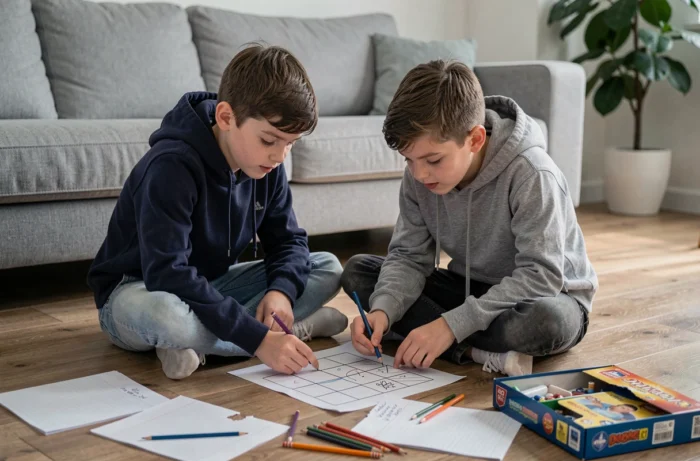
Games with simple rules become accessible: tic-tac-toe, hangman, dots and boxes. These games introduce the strategic dimension. The child no longer just produces; they anticipate, they react to the opponent. The small bac, adapted with simple categories (animals, first names, colors), simultaneously works on vocabulary and speed of association.
After Eight Years
More elaborate games take over: battleship, paper racing games (tracing paths on a grid), or creating comic strips. At this age, the child can design a complete universe on a sheet, invent characters with unique traits, and develop scenarios. The materials remain the same (paper, pencil), but cognitive complexity increases significantly.
Creative Space at Home: Organizing a Drawing Corner Without Expensive Materials
Stimulating creativity with paper and pencil does not require a significant investment. A clear table, a stock of sheets (scrap, recycled, of different sizes), and a few pencils are sufficient. The key factor is the constant availability of materials: a child who has to ask for permission or search for their pencils loses spontaneous momentum.
Varying the supports enriches the experience without complicating the organization:
- Kraft paper or lightweight cardboard changes the texture under the pencil and encourages the child to adapt their gesture.
- Large format sheets (like A3 or rolls) free up arm movement and encourage ambitious compositions.
- A simple dedicated notebook, which the child fills freely over the weeks, creates a personal object that values their production.
The space does not need to be isolated or silent. A corner of the kitchen table, accessible at any time, works better than a tidy workshop with a closed door. What matters is that the child perceives drawing and paper games as an activity as natural and available as speaking.
Paper and pencil remain, among all the creative tools accessible to children, those that offer the best balance between simplicity of the medium and richness of the cognitive experience. No application, no matter how well designed, replicates this combination of physical constraint, total freedom, and immediate sensory feedback.