When preparing a trip to Brittany, you quickly find yourself with a packed itinerary between Saint-Malo, the Pointe du Raz, and Carnac, leaving no room for what makes the region special: its living traditions, its coastal paths sometimes subject to access restrictions, and a soft mobility offer that has changed the game in recent seasons.
Access restrictions on the Breton coast: what to check before leaving
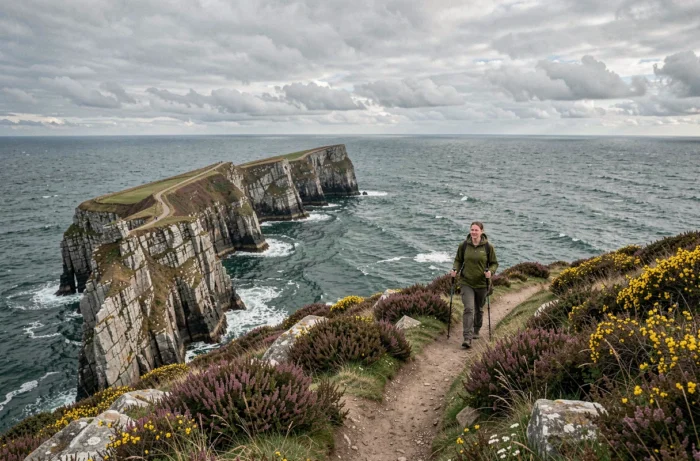
We don’t always think about it, but some major natural sites in Brittany are now subject to local access regulation measures. The Cap d’Erquy and portions of the GR34 in the Côtes-d’Armor are affected by temporary bans related to fire risk and the preservation of natural spaces.
Before hiking on the north coast, you must consult the municipal orders in effect. Conditions change throughout the season, sometimes from one week to the next. The Cap Fréhel is also affected by these measures.
This is not a minor logistical detail. Finding yourself in front of a closed path with young children after an hour’s drive can ruin a plan. It is recommended to check the information the day before departure, directly with local tourist offices or on bretagne-region.com, which centralizes practical information about the region.
Breton heritage and local traditions: beyond postcards
Brittany has a rich religious, megalithic, and architectural heritage that goes beyond the alignments of Carnac. The Gavrinis cairn, in Morbihan, now radiates well beyond the region. This megalithic site, accessible only by boat, offers interior engravings whose finesse surprises even visitors accustomed to prehistoric sites.
In terms of living traditions, fest-noz remain regular events in rural communities, not just summer tourist events. People dance the gavotte or the an dro in community halls or outdoors, with musicians playing the biniou and bombarde.
The Petites Cités de Caractère, an alternative to crowded sites
Rather than focusing on major destinations, it is beneficial to explore the towns labeled as Petites Cités de Caractère. These municipalities offer preserved architectural heritage without the tourist pressure of major sites. Half-timbered houses, chapels, restored washhouses: the pace of visiting changes.
- Moncontour, in the Côtes-d’Armor, with its medieval ramparts and remarkable stained glass in the Saint-Mathurin church
- Rochefort-en-Terre, in Morbihan, where half-timbered houses and art galleries attract without overwhelming
- Jugon-les-Lacs, between Dinan and Lamballe, a starting point for hikes around the pond
These stops fit well into an itinerary that alternates between the coast and the interior, especially if traveling with young children and looking for quiet breaks.
Train and bike in Brittany: a growing combination
The Brittany Region has strengthened its rail offer on several routes, with a clear goal: to combine train and bike for tourist travel. Electric bike services can now be found at the exit of several Breton train stations.
Greenways are also developing. In the Côtes-d’Armor, the use of hiking trails and greenways is increasing, documented by the departmental tourist observatory. The Dinard axis illustrates this trend well, with a greenway becoming a major axis of soft mobility.
Organizing a car-free stay in Brittany
It is feasible, but it requires preparation. Feedback varies on this point: some routes are well served (Rennes-Saint-Malo, Rennes-Brest), while others require bus connections that extend travel times.
- Prefer the train stations of Rennes, Saint-Brieuc, or Morlaix as starting points for biking
- Book an electric bike in advance during peak season, as stocks are limited in small train stations
- Combine the GR34 (customs path) with train-accessible stages for the practicable sections
- Check access restrictions on coastal sections before finalizing the itinerary
Breton gastronomy and quality labels: what is changing
We won’t redo the list of crepes-cider-seafood. What deserves attention is the evolution of labels. The Destination d’Excellence label is gradually replacing Qualité Tourisme and incorporates eco-responsibility requirements in addition to quality of welcome. Three Breton tourist offices have already obtained it.
For accommodations, the Le Meur law adopted at the end of 2024 has modified the taxation and declaration obligations of tourist rentals. In Brittany, where pressure on housing and second homes is a major territorial issue, this regulation is reshaping the seasonal rental offer. Municipalities now have expanded powers to regulate short-term rentals.
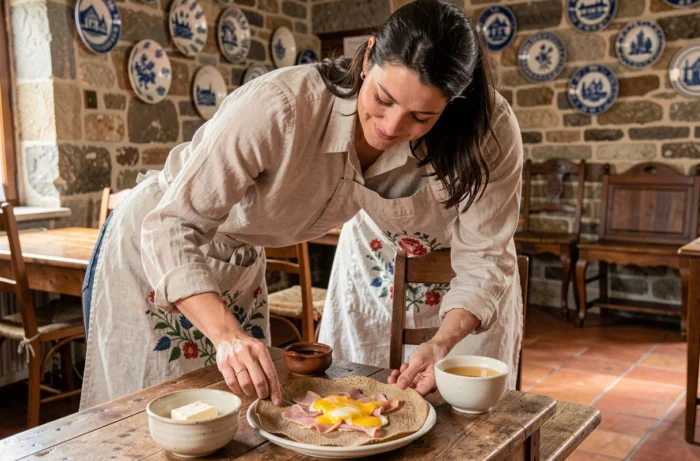
On the dining side, local products can be easily found at Saturday morning markets in the inland towns. Guémené sausage, artisanal kouign-amann, Cancale oysters: quality depends on the short supply chain, not on the label displayed in the window.
Breton landscapes: choosing between the north coast, south coast, and inland
The north coast (Pink Granite Coast, Bay of Saint-Brieuc) offers wilder and windier landscapes. The south coast (Gulf of Morbihan, Quiberon Peninsula) has calmer waters and a slightly milder climate. The inland areas remain underrated, with the Arrée mountains, Brocéliande forests, and navigable canals.
The choice depends on what you are looking for: challenging hikes on cliffs or family strolls on sheltered beaches. Both work, but not with the same equipment or preparation.
Brittany is best visited when you accept to slow down. Check access before leaving, prefer small towns over crowded spots, and try the train-bike combination on a section: all simple adjustments to make before departure rather than on-site.