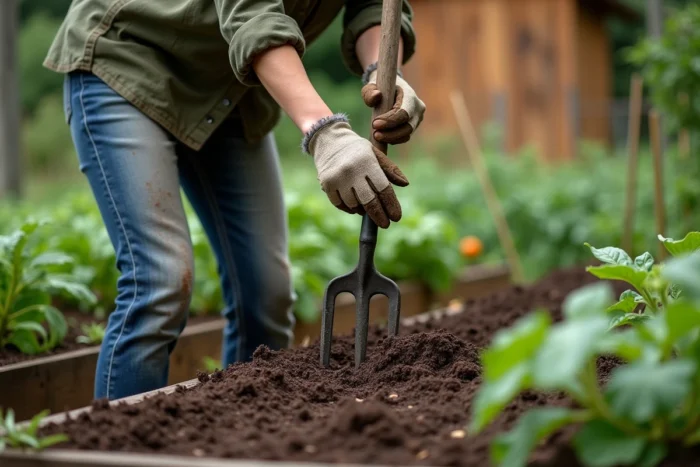
The grelinette loosens the soil without turning it over. This simple principle profoundly changes the way an organic vegetable garden functions, from microbial activity to water retention. Measuring the differences between this tool and traditional alternatives (spade, tiller) helps to understand why it is favored in gardens where soil life guides decisions.
Grelinette, spade, and tiller: comparison of effects on living soil
Comparing these three tools based on concrete criteria helps to go beyond subjective impressions. The table below summarizes the differences observed in a small vegetable garden.
| Criterion | Grelinette | Spade | Tiller |
|---|---|---|---|
| Soil turning | No (vertical loosening) | Yes (layer inversion) | Yes (fragmentation and mixing) |
| Impact on microbial life | Preserved | Disrupted (layers inverted) | Severely disrupted |
| Risk of plow pan | None | Moderate | High (repeated passes) |
| Physical effort (back) | Low (upright posture, lever) | High (lumbar flexion) | Variable (vibrations) |
| Suitable for permanent beds | Yes | Poorly suited | Not recommended |
| External energy required | None | None | Fuel or electricity |
The tiller fragments the soil on the surface but creates a compacted layer below the worked area. In a small vegetable garden, this plow pan reduces drainage and blocks root progression. The spade causes a different problem: by inverting the layers, it exposes anaerobic microorganisms to air and buries those that need oxygen. Both disturbances hinder the natural fertility of the soil.
Specialized resources like grelinette-warrior.com detail the technical characteristics of the different models available to tailor the choice of tool to the nature of your land.
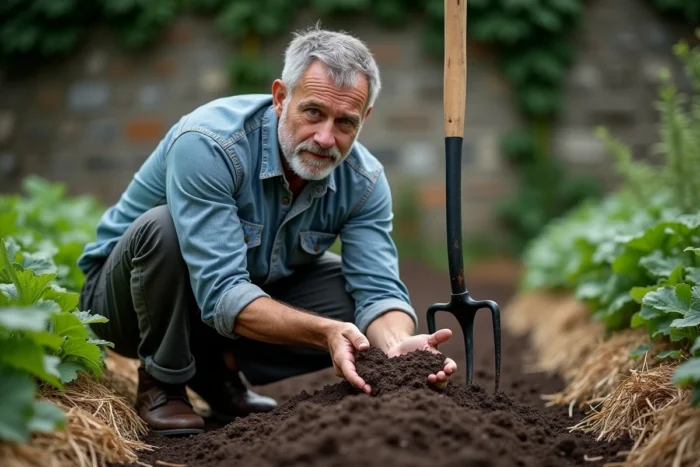
Compacted soil after rain: the grelinette as a restoration tool
Intense rain episodes followed by heat transform the top layer of soil into a hard crust. This phenomenon of crusting particularly affects clay and loamy soils. Intervening with a tiller at this stage worsens the compaction below.
The grelinette allows intervention during a specific window when the soil is moist but not sticky. By pushing the tines vertically and then tilting the handles backward, the crust is cracked without mixing the horizons. The next rainfall infiltrates instead of running off.
This action is most relevant in the fall, after harvests, or in early spring before sowing. Outside of these windows, working overly wet soil with any tool (including the grelinette) risks creating compact clods that will take months to break apart.
Recognizing the right time to intervene
- Take a handful of soil and squeeze it: if it forms a ball that crumbles when you tap it, the soil is ready to be worked.
- If the ball remains sticky and shiny, the soil is too wet. Wait a few days without rain.
- If the soil is powdery and does not form a ball, it is too dry. Light watering the day before facilitates the tool’s passage.
Permanent beds in permaculture: why the grelinette changes the logic of cultivation
In a vegetable garden organized into permanent beds, the fundamental principle is to never walk on the cultivated area. The grelinette is used from the pathways, without stepping on the bed. This detail eliminates the compaction caused by foot traffic, the main cause of compaction in small gardens.
In contrast, the spade requires you to stand on the surface to be worked. The tiller, due to its weight and wheels, compacts the soil across its entire width of passage. On beds less than a meter wide, these two tools create more problems than they solve.
The grelinette fits into a cycle where the soil is never left bare between crops. After using the tool, mulching or sowing green manure covers the surface. Microorganisms, preserved by the absence of turning, decompose this organic matter and transform it into nutrients that can be absorbed by subsequent plants.
Fewer passes, more fertility
A vegetable garden worked with a tiller often requires several passes to achieve fine soil. Each pass destroys part of the mycorrhizal fungal network, those filaments that connect plant roots to soil nutrients. The grelinette requires only one pass. The fungal network remains intact and continues to nourish the crops.
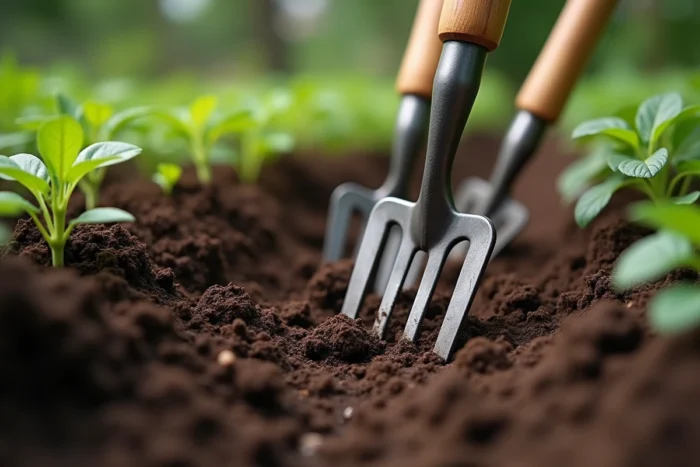
Ergonomics and durability: two measurable criteria for the organic gardener
The two-handled design of the grelinette distributes the effort across both arms and the torso. The tilting motion uses body weight as the driving force, not the muscular strength of the back. For gardeners who work their vegetable garden several times a season, this biomechanical difference reduces the risk of lower back pain.
In terms of durability, a grelinette made of forged steel with hardwood handles contains no electronic components or complex wear parts. Maintenance is limited to cleaning the tines after use and oiling the metal at the end of the season. This level of mechanical simplicity explains the tool’s longevity over several decades of regular use.
- The upright posture while working protects the lumbar discs, a decisive advantage for gardeners who maintain their vegetable garden beyond the age of fifty.
- The absence of a motor eliminates noise, vibrations transmitted to the hands and arms, and dependence on an external energy source.
- The number of tines (generally three to five) is chosen based on the width of the beds and the density of the soil, which avoids forcing an unsuitable model.
The grelinette does not replace all tools in the vegetable garden. It is not used for digging deep holes or working a plot overrun with thick roots. Its relevance focuses on the regular loosening of already cultivated soils, where preserving soil biology produces cumulative results season after season. For an organic vegetable garden, it is precisely this type of gradual gain that makes the difference between a soil that depletes and a soil that enriches.