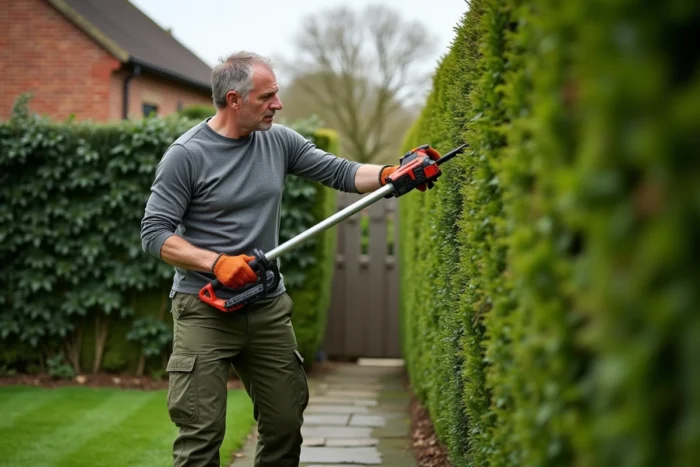
Trimming the top of a three-meter hedge from the ground, without a ladder or contortion, radically changes the gardening experience. The telescopic hedge trimmer makes this task accessible, provided you choose a model suited to your hedges and master a few cutting techniques. Here are the points that make the difference between an effective tool and a disappointing purchase.
Spacing of teeth and branch diameter: the criterion that few gardeners check
Have you ever seen a blade get stuck mid-cut on a slightly thick branch? This problem almost always arises from a poor relationship between the spacing of the teeth and the diameter of the branches to be cut.
On a laurel, privet, or hornbeam hedge, the branches remain thin and flexible. A standard tooth spacing is sufficient. However, for woody hedges with branches exceeding 25 mm, aim for a tooth spacing of at least 36 mm. Below this, blockages become frequent, damage the blade, and strain the motor.
This criterion rarely tops product sheets. Yet it deserves to be checked before the power or blade length, as it directly determines what the tool can actually cut. Specialized resources like taille-haie-telescopique.com allow for comparison of models on this specific point.
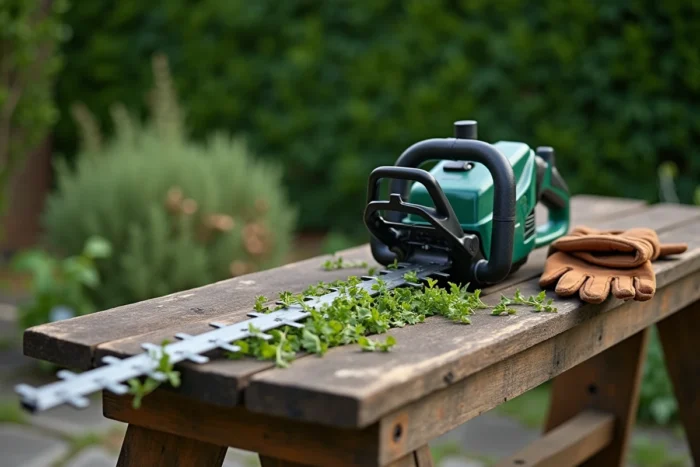
Weight at the end of the pole and muscle fatigue: the five-kilo limit
A telescopic hedge trimmer is held with arms raised, sometimes for an hour. The weight felt at the end of the pole is much greater than the weight indicated on the technical sheet, because the lever effect amplifies every gram.
Recent professional guides recommend not exceeding five kilos with a harness for prolonged use. Beyond that, the risk of musculoskeletal disorders increases, especially in the shoulders and wrists.
How to assess comfort before purchase
The total weight is not enough. Two models of the same mass can offer very different comfort depending on the weight distribution. A motor placed at the bottom of the pole, near the hands, is less tiring than a motor block located at the cutting head.
- Check if the model comes with a shoulder harness or strap. Their absence on a tool over four kilos is a warning sign.
- Test the grip with the pole extended to its maximum length. Some gardening stores allow this.
- Prefer ergonomic rotating handles, which allow for angle changes without twisting the wrist.
Shared battery or wired power: a choice that depends on your tool collection
The choice between corded electric, battery, or gas is not just a matter of power. 18V or 36V batteries are now shared among several tools in the same range: mower, blower, chainsaw, hedge trimmer. If you already own one or two compatible batteries, the cordless telescopic hedge trimmer becomes significantly more cost-effective.
Corded: reliable but limiting in height
The corded electric model remains the lightest and cheapest. It is suitable for small gardens where a twenty-meter extension is sufficient. However, handling a cable at three meters high with a pole requires attention. The cord gets caught in the cut branches and hinders lateral movements.
Battery: freedom of movement, but watch out for autonomy
A battery-powered hedge trimmer offers total mobility. The actual autonomy depends on the diameter of the branches cut, not just the stated capacity. Trimming fine boxwood consumes much less energy than tackling woody thuja. Plan for a spare battery if your hedge exceeds thirty linear meters.
Gas: powerful but heavy
The gas telescopic hedge trimmer delivers the best cutting power. It is aimed at thick, long hedges with hard branches. Its main drawback remains the weight and noise. For a residential garden, the battery model often replaces it advantageously in most situations.

Cutting technique with a telescopic hedge trimmer: from bottom to top
The temptation is strong to start from the top of the hedge. Resist. Always trim from the bottom to the top, gradually working your way up. Debris falls naturally and does not obstruct the cutting of the lower parts.
Tilt the cutting head slightly (about ten degrees) so that the blade attacks the branches at an angle. This tilt reduces vibrations and improves the sharpness of the cut. On the top of the hedge, move the blade in a slow sweeping motion, maintaining a consistent angle.
Blade maintenance after each session
A blade caked with sap cuts poorly from the second use. After each trimming, wipe the blade with a cloth soaked in an appropriate resin-removing product. Check the sharpening every three or four uses. A well-maintained blade extends the motor’s lifespan, as it requires less mechanical effort to cut.
- Clean the blade while hot, just after cutting, when the sap is still fluid.
- Apply a thin layer of protective oil along the entire length before storage.
- Store the tool with a blade sheath to avoid shocks and corrosion.
A well-chosen telescopic hedge trimmer transforms a tedious chore into a quick and precise task. The spacing of the teeth, the weight at the end of the pole, and the battery compatibility with your other tools remain the three criteria to check before any purchase. On the technical side, cutting from bottom to top and systematic blade maintenance make a difference in the field.