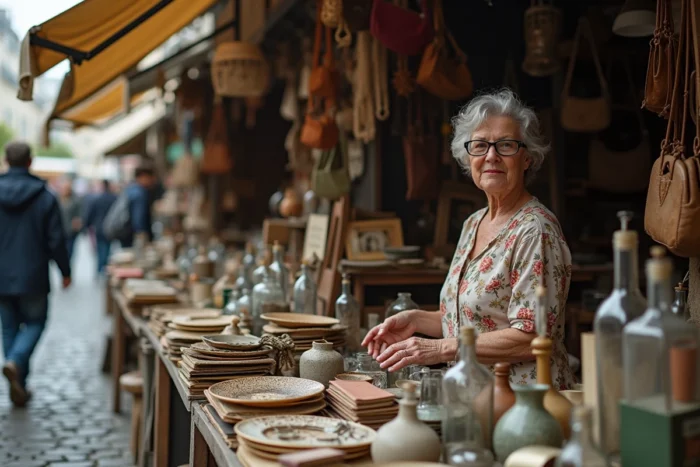
The word “bazardée” has been circulating in French conversations for much longer than one might think. Derived from the verb “bazarder,” which itself comes from “bazar,” it has passed through several layers of meaning before landing in rap lyrics, TikTok stories, and discussions among friends. Its linguistic journey tells as much the story of Eastern commerce as it does of modern romantic breakups.
From Persian bazaar to the verb “bazarder”: a commercial etymology
The noun “bazar” comes from the Persian “bāzār,” which refers to a covered market. The word entered the French language in the 16th century, initially to describe Eastern markets, and then by extension, any place where a certain disorder reigns. The cheap shops bearing this name in the 19th century further gave it a connotation of odds and ends, of things piled up without much value.
From this “bazar” comes the verb “bazarder,” which means to get rid of something, to sell hastily, to liquidate. One bazards a piece of furniture they no longer want, a stock of unsold goods. The gesture is quick, not sentimental, almost brutal. This idea of rejection without ceremony forms the foundation upon which the modern slang meaning has been built.
This shift from commerce to emotion is not exceptional in French. Other verbs have followed the same trajectory: “larguer” comes from maritime vocabulary, “plaquer” from craftsmanship. The informal register readily recycles physical gestures to name emotional breakups, and understanding the definition of bazardée in slang requires keeping this mechanism of transfer in mind.

Bazardée in current slang: what the word really covers
In common usage, “bazardée” today describes a person (most often a woman) perceived as unstable, unpredictable, or emotionally explosive. The term applies to someone who has been “thrown away” by a partner as well as to someone whose behavior is deemed excessive or even self-destructive.
This dual interpretation poses a definition problem. Depending on the context, “she is bazardée” can mean:
- She has been left without regard, abandoned like one gets rid of an object. The passive meaning, close to “larguée” or “jetée.”
- She is deranged, she is spiraling, she is losing control. The active meaning, close to “barée” or “perchée.”
- She has thrown everything away, she has bazarded her previous life. The voluntary meaning, close to “she has lost it” but with a nuance of liberation.
These three meanings coexist, sometimes in the same conversation. The speaker rarely chooses to specify which one they are using, and it is precisely this ambiguity that gives the word its emotional weight. A “bazardée” person is both a victim and an actor in their own chaos.
A gendered word?
The feminine form (“bazardée” rather than “bazardé”) largely dominates online usage. The available data does not allow us to conclude whether this is a frequency bias related to the eponymous song or a deeper trend. However, it is observed that the term is predominantly applied to women in TikTok and Instagram content, often in “POV” formats or breakup stories.
Music and social media: the two accelerators of the word bazardée
The song “Bazardée” performed by KeBlack has played a catalytic role. The song places the word in a sentimental register, that of a damaged relationship, of the woman who has been mistreated. The commercial success of the track has exposed the term far beyond the circle where it was already circulating.
The dissemination then continued through a different channel. On TikTok and Instagram, content creators have incorporated “bazardée” into their humorous videos and storytelling capsules. The word is used to describe behaviors deemed “toxic” or “drama” in emotional and friendly relationships.
This adoption by micro-influencers and short formats has anchored the term in the everyday vocabulary of a generation that may not have discovered it through music.
The result is a word that lives on two parallel platforms: the song, which gives it a poetic and melancholic dimension, and social media, which pulls it towards humor, caricature, and memes. These two registers feed off each other without merging.
Why bazardée endures where other slang words disappear
French slang renews its vocabulary at a rapid pace. Terms that are very popular for a few months fall into disuse as soon as they are perceived as dated or co-opted by too broad an audience. “Bazardée” has so far escaped this cycle, and several factors explain this.
First, the word is phonemically satisfying. The four syllables, the sound of the central “z,” and the final “ée” give it a rhythm that lends itself well to singing, slamming, and punchlines. A word that is pleasant to pronounce is more likely to survive than a technical or awkward term.
Next, its semantic ambiguity (mentioned earlier) allows it to adapt to very varied situations. A word that only means one thing eventually becomes tiresome. A word that conveys several meanings remains useful longer.
Finally, “bazardée” is neither an English loanword nor a pure neologism. It relies on a verb that every French speaker intuitively understands. Its familiar root gives it a legitimacy that English calques lack, which facilitates its adoption by speakers of all ages, including those who do not frequent TikTok.
The word has not yet made its way into reference dictionaries in its contemporary slang sense. Field reports diverge on this point: some lexicographers consider it a simple figurative use of “bazarder,” which is already listed, while others believe that the shift towards characterizing a person (and no longer an object) would justify a distinct entry. This question remains open, and it may be a sign that the word has not finished evolving.